An Initiative of Ministry of Human Resource Development
under the National Mission on Education through ICT
www.vlabs.iitb.ac.in
🏫 NCID – Institute Name:
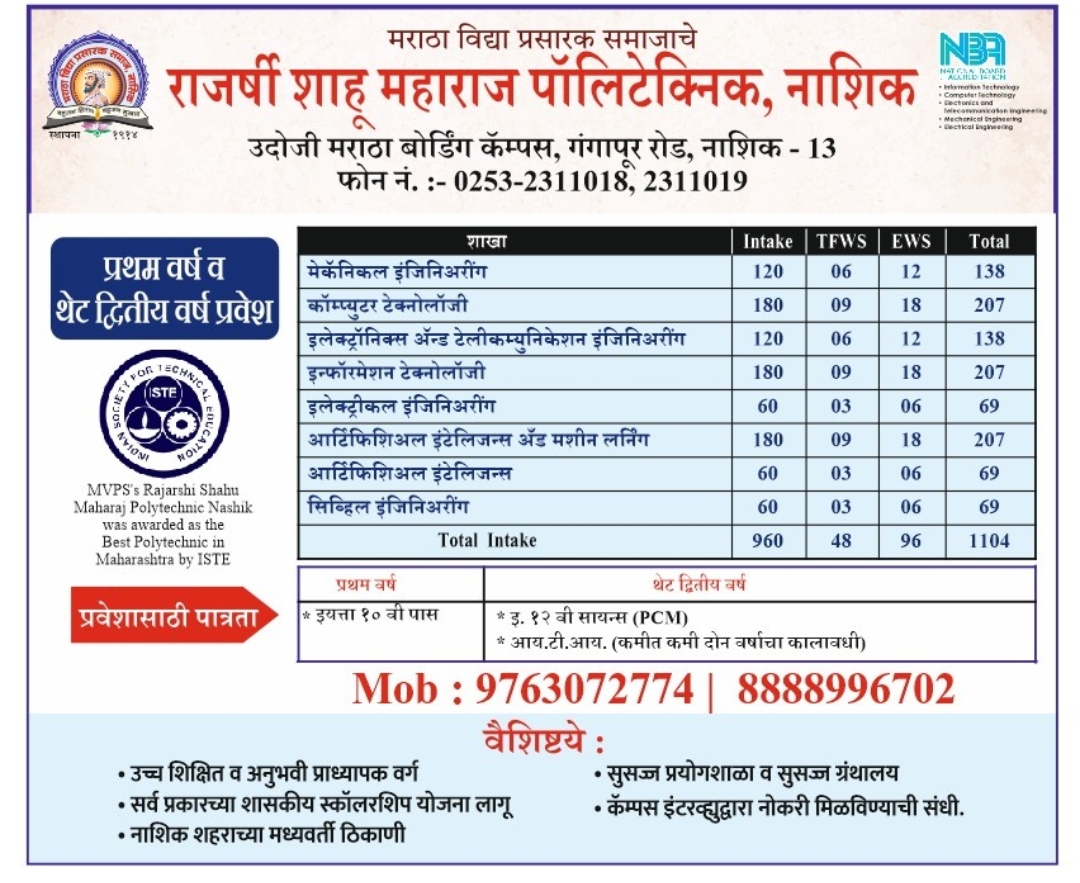
246 – Maratha Vidya Prasarak Samaj’s, Rajarshi Shahu Maharaj Polytechnic, Nashik
 |
Prof. A. H. Kale
M.E.(VLSI & Embedded Sys.), B.E.(Electronics)
Lecturer
Contact : 8329140570
Email : ashvini.kale.suryawanshi@rsmpoly.org |
Areas of Research:
1. VLSI and Embedded System
Experience : 2.5 Years
|
| Nodal Technical Coordinator |
| |
Prof. H. N. Ugale
ME(Computer Engineering), B.E.(Computer)
Lecturer
Contact : 9423007514
Email :hemant.ugale@rsmpoly.org |
Areas of Research:
1. Cloud Computing
2. Data Science
Experience : 1 Year
|
🔬 Virtual Labs
Virtual Labs is an initiative of the
Ministry of Human Resource Development (MHRD), Government of India,
under the National Mission on Education through Information and Communication Technology (NMEICT).
A Virtual Laboratory is a computer-based learning environment that enables students to perform experiments remotely using simulations and interactive tools. It provides access to laboratory resources anytime, anywhere, making practical learning more effective and accessible.
🎯 Objectives
- Provide remote access to laboratories in various disciplines of Science and Engineering.
- Support undergraduate, postgraduate students and research scholars.
- Encourage curiosity through interactive experimentation.
- Enable learning of basic and advanced concepts through remote experiments.
- Provide a complete Learning Management System including videos, animations, self-assessment, and web resources.
- Share expensive laboratory equipment and resources beyond geographical limitations.
⭐ Importance of Virtual Labs
- Provides simulated laboratory experiments through an online environment.
- Allows students to safely perform practical experiments using computer simulations.
- Develops laboratory skills through interactive learning without time or location constraints.
🎓 Benefits of Virtual Labs
✔ Safe practical experiments without physical risks.
✔ Saves time and travel for students and teachers.
✔ Learn and practice using the latest technologies.
✔ Repeat experiments multiple times for better understanding.
✔ Record, save and share observations electronically.
✔ Supports flexible learning from anywhere at any time.
✔ Protects users from hazardous chemicals and electrical risks.
✔ Enhances understanding of theoretical concepts through practical simulations.